Balance

I’ve talked before about struggling to find balance as a writer and a mother.  It’s something I often fail at, and sadly my writing is one of the first things I give up when something else needs to be done.  Partially that’s because I’m a terrible procrastinator.  More often, though, it’s because something is going on that kills my mood.

Screen Shot 2013-10-15 at 6.14.17 AM

I struggle to write erotica when my mood is anything but sexy.  When my kid is puking.  When I’m so tired from my day that I fall asleep at my laptop (ironically, though, I’m writing this at 6am after not having slept all night).  When watching tv feels like a challenge.  When I the only time I can carve out is in the parent cafe of an indoor playground.  When the mood isn’t sexy, each word is akin to pulling teeth.

We are heading toward year’s end at a frenetic pace.  It’s early yet, but I’m starting to think about 2014, and how I would like it to be different.  I want to prioritize my writing.  I want to carve out sacred time that is only put aside in extreme cases.

Screen Shot 2013-10-15 at 6.12.10 AM

Very soon NaNoWriMo will start.  I won’t be starting a new story, but I do plan to use it as a motivational tool to kickstart my progress with the novel.

Do you struggle with balance?  What do you give up to write?  Do you give up writing to get other things (even something like grocery shopping) done?  What’s your approach?

Seen in New Zealand

I wandered into a awesome sex toy store in New Zealand and saw Irresistible (the first book I was published in) sitting on the shelf.  Hooray!

Interview with my editor

Although I’ve been writing erotic fiction for roughly 11 years now, having an editor is a thing for me.  I first worked with an editor when I wrote for Carnal Nation.  I first thought to work with an editor for my fiction after Carnal Nation shuttered its doors.  I tried a few people, but I never found the right person.

A friend of mine offered to look at a story of mine last year.  I sent it over to her, and thus began my professional relationship with Jessica Augustsson.  Over the past year, I’ve really seen the quality of my work go up.  We’ve worked together on (if I haven’t lost count, and I think I may have) 5 short stories, and she is now editing as I work on my novel.  She is my go-to reader, and I can offer no higher praise than to say that I credit my recent acceptances in no small part to her editorial eye.  I’ve also learned what some of my “usual suspect” faults are as a writer, and now when I edit my own work, I have a sharper eye for those faults.

Worth noting-my blog is very much a first draft/off the cuff writing, so don’t blame any of my faults on the blog here on her!

I thought it would be fun to ask her some questions and publish her answers on the blog.  I know many of my readers are also writers, so you may find her answers enlightening.

pith_helmet_2Holder of the metaphorical red pen…

1-How did you become interested in editing?

Oh, gosh. I don’t know really. I think maybe there is something in the things we love to do that emerge even at an early age? I have distinct memories of my grandfather teaching me to read using magnetic letters on an old coal-burning stove we had in our house when I was a kid. Throughout school and well into college, I always enjoyed my English classes, both the literature aspect AND the grammar aspect, but never had an inkling of what kind of career one should have with an English degree. So even though they were the classes I loved the most, I sort of pushed the idea aside. I was focusing on political science, particularly international politics, which is a bit ironic too, I suppose. 🙂 And then out of necessity, once I was living and attending university in Sweden, I needed a way to earn extra money. Well, the English department had a deal with the business school, and some of us English students would edit their business theses. The pay was pretty low, but it was at a time when every little bit helps, and I really sort of enjoyed it, even though the subjects might not have been all that riveting. (I have a LOT of semi-useless knowledge about Sweden’s wood pulp industry now, and how a recent name change did NOT go over well in France! *grin*)

Then, off and on, I did some editing and translating for some software companies through people my husband knew. Then finally after finishing my Master’s, I became a technical writer and editor for a software company in 1999. After about seven years with them, I worked for a company that assigns projects to freelancers for just under a year before going out on my own. I learned some really valuable things while working for them, such as what sorts of texts people tend to want editing for, what various publishers expect, and the large and small differences between different English speaking countries’ general editing rules, as well as a few different diplomacy tools for working with a variety of clients. However, these sorts of companies that farm out projects take an extremely large chunk of the fee, and it was just unsustainable for me in the long run, as far as living expenses and such, to continue working for them.  Fortunately, when I took the leap of going out on my own, a few of the clients I’d asked about giving me possible references decided to come with me.

So my way of becoming a copyeditor was perhaps not the typical track. I’m not really aware of how things might be for those who worked directly for publishing companies or newspapers.  I do know many companies like to have lists of freelancers who’ve proven reliable, and through word of mouth, I’ve managed to get myself added to a couple of those lists.  But that channel of work doesn’t provide much, so self-advertisement is still key for freelancers.

2-What sorts of things do you edit?

Hmm… I really think it might be easier to say what I _haven’t_ edited. 🙂

I really enjoy my work because the variety is so…er…varied! From medical and scientific journal articles to museum leaflets to erotic and science fiction short stories to full-length fiction and non-fiction manuscripts. I’ve even helped ghost-write a novel and some short stories.

3-When an author sends you a piece, what is your process?

I always offer a sample edit, so usually that’s the first thing I do. I find this gives me a chance to see what level of editing might be needed (and gear my fee and time allotment accordingly), and gives the potential client a chance to see what kind of edit they’re going to get in return. That way, if they just don’t feel like we’re going to mesh, they can decide not to hire me. That’s usually fine by me, as sometimes it can be more work to discuss disagreements than it is to simply edit a document. (This sounds really awful, doesn’t it? Basically, I try to offer suggestions to improve grammar, flow, clarity, etc., and if a client decides not to go along with that suggestion, that’s obviously up to them. But I’ve had clients try to explain to me with each and every item why their way is better and want to know in detail why I made the suggestion I made. (Which, by the way, I have no problem with explaining, but in one case the client asked this repeatedly for weeks for everything I edited and it ended up being such a time and mental energy suck.)) In any case, I like to give people the view of what to expect up front, so they can make a determination as to whether they’d like to use my services. Based on comments on my website, you can see that most people are pretty happy. 🙂

Anyway, after that, I’ve found with shorter works, I edit them, just using the first-time reader eyes to inspire thoughts and questions as I go through, which can help point out places that need clarification, etc. Then I send the work back to the author and they can look through, make changes if they like, and send it back, as I always include a quick second read-through in my fees. This is because I know writing and polishing that writing is a process and not just a one-time fix-it-and-it’s-done deal. Sometimes when we change things, other little errors can creep in, too, without us realizing it, so I always try to keep an eye out for those in the second read-through.

For longer works, I usually do basically the same process as above, but on a chapter-by-chapter or section-by-section basis. I used to do the whole thing before replying, but I found through the years that if only a short section is edited at a time, this gives the author a chance to see the comments in say the first chapter, notice this is something they have a problem with throughout the novel, and they can fix the second chapter before sending it to me for the first edit. This gives them a better edit, since I’m not only highlighting the same thing throughout, and helps them develop their writing skills at the same time.

4-I’m sure every author (me included) fantasizes about getting back a piece with the “perfect! No errors!” back from their editor. Does that ever happen?

🙂  No, I’m afraid not. Not even on my own writing! Fresh eyes will always find something. I have a couple of people I trust to edit my own work, but for real story submissions and things like that, I’m never going to send out my work unlooked at by someone else. No matter how good a writer you are, how excellent your grammar skills, there will always be a typo, a reference error, a subject-verb disagreement due to having changed a sentence somewhere along the line. Plus, when we write, we’re trying to get mental images down into words on paper (or the computer screen). When we do this, a lot of material gets left in our heads. We see it clearly because we know what’s going on. But someone else who reads it won’t have all the data you have, and so a lot of my red marks in stories have to do with that–helping the author complete the picture on paper so it matches as closely as possible the one in their heads.

5-How do you balance yelling an author where their work needs help/clarification/etc and not making them cry. I ask because your comments always motivate rather than deflate me.

Diplomacy definitely turned out to be a lot bigger part of my job than I’d first imagined. But there has to be this understanding that people’s writing work, whether it’s a story or a PhD thesis, is their baby. And here I am slashing it up and sending it back to them as a big red, blobby mess. The important thing to do is much of what psychology teaches. You don’t tell somebody that they did something _wrong_ or that they wrote badly. Writing is so subjective anyway. So instead of merely saying something is unclear, for example, I will try to also add a suggestion or a question showing what kinds of questions the part that’s unclear is prompting in my head.

6-Do you have any advice you wish authors could hear before they send you their work?

That a quality edit is going to take longer to edit than they think. Time and time again I’ve had people send me really long theses that are due the next Monday or full-length manuscripts that they think should be ready for publication in a month. As a substantive editor, I know it’s going to take longer than that for even the absolute best of writers–and no, it’s not _just_ because I’m slow. 🙂

The other thing which is tied back to the previous thing is that many authors think that they just hand their manuscripts over to me and I hand them back a ready-to-publish copy–that I’m going to “fix it” and all will be done and pristine. People need to understand that the editing process is a back and forth thing. It’s going to require just as much work (or more) from them as it is from me before they have a publishable copy of anything. This is also why it takes a long time.

Then it would be nice if they also knew that once an agency or publisher has accepted their work, they will likely run it through another editing stage. This does not mean they have wasted their money on me. What I do is substantive editing, and what the in-house editor does is final editing that prepares it for publication by going through and generally polishing, fixing formatting, and some mild line editing and typo corrections–yes, those are going to creep in too. Even the best of us are human. I help people get their foot in the door as best I can. But there will almost always be a bit more editing to come. Writing’s a looooong process.

JessEdit.com

Novel

I have made the terrifying decision to commit to writing a novel.  I’ve successfully been writing, submitting, and occasionally getting accepted to short story anthologies for a few years now.  I feel like I can legitimately call myself an author.

I have grown tremendously as an author these last few years.  Every story has been an opportunity to grow, every rejection a lesson (sometimes you own that a story wasn’t ready, or that sometimes a story is solid and just didn’t work for this anthology), every acceptance a special thrill. 

When I was a child, I loved books. I still do.  I’ve always looked at authors as magical beings-they create worlds and populate them, they invent people who I care about as if they were real, and best of all they share those people and worlds with me. 

I regard authors like Anne Bishop, Maureen Johnson, Alison Tyler, Susan Kay, Lillian Jackson Braun, Mercedes Lackey and countless others in the same way other people sit in awe of athletes, musicians, actors and so forth. 

I respect them, but like a sports team, there can be bad seasons.  Mercedes Lackey-every Valdemar book after either the Winds or Storm trilogy depending on my mood has sucked to the point where I’ve had to abandon the series.  Yet her Vanyel trilogy of Magic’s Pawn, Magic’s Pride and Magic’s Price remains a pivotal series in my development as a person because Vanyel was the first gay person I’d met and cared about. 

Then there are the amazing seasons. I reread the Jewels series by Anne Bishop regularly because I’ve grown to love those characters so much I want to visit with them regularly.  I reread Gone With the Wind every few years because my opinion of Scarlett and understanding of her actions has changed dramatically as I’ve aged-what I found impressive as a teen looks the poorly thought out impulses of an idiot 16 year old from the lofty age of 34.

I want to do that.  I want to be the kind of author who leaves you wanting to know what happens next, to see more of my worlds, and inspires you to care about my characters.  I truly hope that people feel that way about my stories, especially my new acceptances when the anthologies they’re included in come out.

But the dream has always extended past short stories.  I want to write a book where I’m not one of many, and you buy it because my world intrigues you. 

That is what I’m embarking upon-writing my first full length novel.  I’ve hired Jessica, who is both a personal friend and a professional editor to figuratively crack the whip-giving me deadlines and feedback.  Obviously I hope the book will be published. Even if it isn’t,  I know the experience will be invaluable in the lessons I’ll learn.  With hard work and persistence I believe I will publish novel length stories as well.

I still plan to work on short stories. They provide a break from the world of the novel.  As stories are accepted, they help build my resume.  Writing credentials may help my novels’ odds of getting fished out of the slush pile.

Wish me luck.

Beta Readers

I’m in the process of wrapping up my third story submission for the year. 

When I write a story for submission, I try to get a full first draft together. I’ll let it sit for a day or two. Then I try to edit for my common sins-run on sentences, irrelevant tangents, and working on being more concise. I read my story aloud to look for awkward phrasing, or a missed word (you’d be surprised how you can forget to type the word and or what have you, and when reading it, your brain often adds it in).

Next comes the beta reading and response stage.

Screen Shot 2013-05-24 at 12.18.16 PMsource

I am a good writer, but what takes my stories from “okay” to “publishable” is taking advice from beta readers.

Some of my beta readers give me grammatical feedback. However, this has more to do with the fact that I know a few serious grammar nerds than with what beta readers most frequently do.

The majority of beta reader feedback is content specific. Their feedback helps me understand when I’m giving too much set-up (or not enough), what darlings I need to kill (those details in the story that you love, but may be irrelevant to the actual plot), and what improvements I need to make.

I’ll listen to their advice and edit.

I try to get multiple perspectives. Every reader has a different world view and different experiences they bring to the reading experience. Those various perspectives help you get a wider view of your story and the strengths and weaknesses.

The story I’m currently working on takes place at the Boston Tea Party Ship and Museum (a former workplace of mine). My beta readers who are also from the Boston area all picked up on the Tea Party references (which were minimal in the first version). It’s a huge part of our social studies curriculum growing up, so they didn’t have a lot of feedback on that. My friend in Seattle was able to figure out the reference because she knew I’d worked there. Otherwise she wouldn’t have picked up on those same references because the Tea Party isn’t emphasized as much outside our part of the US. I realized that I needed to go back and do some edits to be more specific/show my setting in a different way because of her feedback.

I’ll repeat these steps as necessary until I think I have the best version of the story possible.

Do I give my beta readers every single fix they ask for? No, I don’t. At the end of the day, I’m the one with the vision of the story, and I have to listen to my own instincts about the story. Sometimes I disagree with my reader about a character’s personality or motivation, or what have you.

When you submit a story to an editor, you have to send your absolute best work. In my experience with anthologies, you are submitting the story you want published. The editors are not beta readers-they don’t ask you to make a change, or fix something-they accept or reject the story.  I’ve gotten feedback about liking a detail in an acceptance, but I know that when I send in the story, that’s the final draft.

Thanks to my beta readers, I’m far more confident about the quality of the stories I submit.

Shhh! Don’t Tell Anyone… Erotic Fantasies about Sexy Occupations.

So you guys may remember that back in January, I mentioned that I’d gotten an acceptance, but couldn’t tell you anything else?  Well, the time has come for the curtain to lift…

I have a secret. Oh, well. I guess it’s not a secret anymore, because I’m about to hit the “publish” button and send the information out to anyone who cares to peek. Yes, after months of hard work, and a bit of back and forth with my publisher, Cleis Press, I have the table of contents for Shhh! Don’t Tell Anyone… Erotic Fantasies about Sexy Occupations.

This idea lingered on my hard drive for nearly seven years. Some books take longer than others. I’m so pleased to share the TOC with you all.

Introduction: The “Want” Ads
Construction Worker: Grimy by Sommer Marsden
Cowboy: Bonanzed by Kate Pearce
Professor: O for Effort by Delilah Night
Chauffeur: Driver’s Seat by Sophia Valenti
Meteorologist: Warm Front by Heidi Champa
Physician: Doctors Orders by Sasha White
Delivery Boy: Just A Little Tenderness by A.M. Hartnett
Pool Girl: California Dreamin’ by Andrea Dale
Book Binder: Rule of Thumb by Laila Blake
Baker: Kneading Lessons by Tilly Hunter
Personal Trainer: Work It Out by Elisa Sharone
Stage Manager:  SM Or How I Met My Girlfriend by Giselle Renarde
IT guy: Talk Nerdy to Me by Crystal Jordan
Porn Star: Current Photo, Please by Devin Phillips
Mechanic: Body Work by Cora Zane
Museum Curator: Under Her Auspices by Jeremy Edwards
Treat Vendor: Ice Cream Boy and Sprinkle Girl by Kathryn O’Halloran
Barber: Close Shave by Alison Tyler
Alison is an author and editor whose work I love (in case you haven’t noticed) so I’m thrilled to be included in this anthology.
A small excerpt from “O for Effort”

Professor Kumar leaned back in his chair, fingers steepled.  “This is your third class with me.  You’re aware of my no extensions policy.  You’ve been an exemplary student.  So what could keep diligent young woman such as yourself so busy that you skived off on the assignment?”

“The sex,” I confessed, and immediately blushed.

“The sex, Ms. Cohen? You have my attention.  Please, continue.”  His eyes took a slow inventory of my body as if he’d never noticed that I was a woman before.  His gaze lingered at my breasts.  I had skipped a bra today, when it became clear that laundry had also taken a backseat to Paul’s touch.  My nipples hardened, impudently thrusting against the all-too-thin fabric of my t-shirt.  I shifted in my seat, clenching my thighs together under my skirt as my clit swelled.  I felt myself slicken between his unrelenting inspection of my body and my memories of the sex.

“It’s been really intense,” I whispered.  “I’ve never had such powerful orgasms in my life—“

“Let’s see how many times you can come in an hour,” Paul had raised an eyebrow at me in challenge two nights ago.  “In two?  In four?” 

First I’d moaned for more.  Then I’d begged to be fucked.  I hadn’t expected that he’d hold a vibrator to my clit as he did so.  He would let me rest, to allow my system to start to calm.  Then his hands, his mouth, or a toy would find me again.  It was something of a miracle I was capable of walking yesterday, much less finishing a term paper.

“Your excuse for not writing your paper in a timely fashion is that you were busy having too many orgasms?”

Ass Tour: Executive Training by Sophia Valenti

Screen Shot 2013-05-13 at 9.10.12 PM

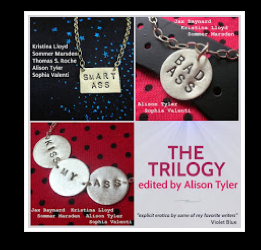
Smart Ass, Bad Ass, Kiss My Ass: The Trilogy edited by Alison Tyler is a compilation of three years worth of anal themed erotica repackaged into a single volume.

Alison tells the following story about the inception of the series

When we first decided to compile a collection of stories about anal sex, I was not sure how readers would respond. Five of us got together and decided to write tight, taut, literary, smutty stories that revolved around backdoor banging. What made the endeavor unique is that we were being bold, not coy and quiet, about our theme. There was no beating around this bush, we stood up tall and proud and called our first collection “Kiss My Ass.”

Within a few months, our sales were soaring and we were receiving reviews like this one from Aisling Weaver: “Each one held me on the edge of my seat, breathless and flushed, eager for every word.”

We knew we wanted to tackle a sequel, but spent some time debating the title. We asked ourselves questions: Do we like writing about anal? Fuck yeah. Do we hide our feelings? No fucking way? Why? Because we are bad asses, which is why we ultimately named our second collection “Bad Ass.”

“Bad Ass” won instant five-star reviews, such as the one that called it “Asstacular” and this one: “So good. It surpasses its predecessor. I read it one quick swallow, but at the end of each story I almost didn’t want to keep reading, because each one is its own little gem, even though they all fit so well together.”

What had begun as a one-off endeavor transformed into an “annual anal” series. Our third installment was “Smart Ass,” which readers were anxiously awaiting.

I’m thoroughly enjoying the trilogy. Today I’ll be reviewing the first story in the book, Executive Training by Sophia Valenti.

Sophia’s story is written in the first person, and we never learn the name of her protagonist. For me, this worked exceedingly well as I related, strongly to her. The following is a description of the protagonist, but it could just as easily describe me.

I was tired of being the responsible one who planned out her days with clinical precision, weighing the pros and cons of every move. I didn’t want to think anymore; I simply wanted to feel.

Valenti blends submission, (potential) exhibitionism, spankings and anal into a well-crafted story. The juxtaposition of the character-a well put together executive exterior-and the woman behind the exterior works well to open the story. The paddle that the protagonist “craved and despised” is one of the most accurate descriptions of a submissive’s relationship with a toy that pushes her limits I’ve seen, and the spanking scene had me squirming-in all the right ways.  I also love that her protagonist had a moment of doubt before going through with her first anal experience. Due to the taboo nature of anal, most people with whom I’ve talked to about anal (which, granted, skewed data sample) confessed to either needing a few tries to go through with it, or at least a second thought before going through with it. That doubt creates a nice element of realism and relatability to the story.

I’m looking forward to the rest of the book, and I highly encourage you to go out and pick up The Trilogy.

An Interview with Mona Darling

Screen Shot 2013-02-25 at 10.57.44 AM

Today I bring you an interview with the fabulous woman behind “Glitter: Real Stories from Real Women about Sexual Desire,” Mona Darling!

1-What gave you the idea for Glitter?
I got the idea at BlogHer’s Pathfinder day last year. We were to draw a map of our life, both talents and experiences to try to see what the lay of land looked like. It was to help us figure out where our strong points lay. This is usually the sort of hippie thing that gives me flash backs to my childhood, but this time, I stuck it out. My map had a ton of little rivers and and mountains and lakes and such representing the many talents I half exceed at. Over the top of everything, was the sex worker sky. The fact that I had been a sex worker for twenty years ment that it touched every part of my life and if I chose to do something non-sex related, it would mean walking away from my knowledge base and all of my contacts. Then I started thinking about all of the stories that friends on twitter had told me about their sex lives and about how much Fifty Shades of Grey was wrongly credited with a female sexual awakening and… suddenly gathering those stories and de-stygmatizing women’s sexuality became a bit of an obsession.
2-Describe the range of experiences in the book and the contributors.
The stories range from basic histories, to stories about specific relationships and encounters. Some of the stories are sexy. Some are just a fascinating look at roads traveled. Many involve shame, or a feeling of not fitting in. Many women have guilt about having sexual curiosities as young girls. Attraction to other women was also a common theme. BDSM, threesomes and and a wide variety of fetishes are discussed. Two women talk about being virgins well past when they expected to have given up that status. I was really impressed and amazed at the diversity of the stories I received. It more then confirmed my suspicions that women are not, in the least, following societies expectations of them, they’ve just been doing in the shame filled dark. And Fifty Shades of Grey had not awakened anything that wasn’t already smiling seductively from the back corners of our psyche. If anything, Fifty Shades of Grey has started to pull back the veil. I would like to rip that veil off.

3-What’s your vision for Glitter?

I see Glitter more as a movement then a simple book. I put together a web site that I hope will grow to be a community site for women to support and understand each others interests and experiences. I in no way think women need to stand on street corners shouting about their interest in kinky sex, polyamory, bisexuality etc, but I DO think they should feel ok owning those feelings privately and not feeling the guilt that so many women feel for not being “normal.” I also want women to be able to discuss rape and assault rather then feeling like they brought it on themselves. Finally, I want everyone to understand that there is no RIGHT way. You are not more enlightened if you are poly or kinky. You are not more virtuous if you are monogamous. The only correct way, is the way that you are most comfortable with.

Hense the motto of the Sisterhood of the Glitter, or, The Glitterhood.
EXPLORE: your interests
RESPECT: others sexuality
DETERMINE: your limits
4-Why did you choose to self-publish?
I decided to self-publish for a couple of reasons. It is such an exciting time in publishing. The barrier to entry is very low and anyone can jump in the fray. There are no rules except the ones you make yourself and the learning curve is unbelievably steep. That’s the kind of world I like. So, even though I was approached by a couple of publishers, the idea of doing it on my own was just too tempting. Also? Traditional publishing is slow and I’m impatient. And of course, there was also the worry that a traditional publisher would want to polish the stories too much or sensationalize certain aspects. I’m in this to make a difference. Not to make a dollar.
5-Where can I get a copy?
Glitter is available on Amazon or through your local book store. Simply walk in proudly and ask them to order it for you if they don’t have it in stock.  It is also available for kindle.
International readers can find it on Book Depository (free shipping worldwide).

6-What else would you like to share?

Join the Glitter Movement at Glitterhood.com. Share your story and offer support to others. Lets end the era of women tearing other women down and start a new era of women supporting each other unconditionally.

Mona Darling spent close to twenty years as an A-list professional dominatrix before becoming a D-list mommy blogger. After spending many years traveling the world being told that she is fabulous, she now spends her days being told she doesn’t drive fast enough by her three-year-old son.

She writes, sporadically, about food, sex and toddler-related mayhem at DeadCowGirl.com.

My spine sucks and other true tales

Although my preferred genre is erotica, at the moment I could easily author a series of essays and package them as a book entitled “My Spine Sucks and Other True Tales.”

My spine has sucked since I was 16 years old and got injured playing tennis my junior year of high school.  I jumped up to hit an overhead shot and when I landed, I fell and hit my tailbone, hard.  I didn’t go to the doctor because of a mixture of youthful invincibility and the reality of being poor and either uninsured or only having crappy welfare insurance.  That summer I got a job bussing tables at a restaurant, which meant I was hauling around super heavy buckets of dirty dishes, which did no favor to my already injured back.  Weeks before senior year began, my back seized up and I finally took it seriously enough to see a doctor, who referred me to a physical therapist.  My physical therapist gave me exercises and a lumbar pillow I was supposed to use any time I was seated.  Not that I wasn’t a giant nerd with no hope in the universe of EVER being a cool senior, but carrying the lumbar pillow around from class to class underlined, bolded and italicized that lack of coolness.

I would diligently do my physical therapy for a few months until I felt “better.”  Then I’d happily drift about my life for a few years, only to have my back start to spasm and seize up again.  Rinse and repeat.

In 2006, weeks before my wedding, I herniated a disc in my spine after I spent a day hauling boxes of books out of my classroom.  I’ve been known to joke that my wedding shouldn’t count because I was high on vicodin and drunk on champagne at the time. Which was the last funny joke I can make about the next few months of my life.

Within eight weeks of our wedding I was confined to bed in our guest room, waiting for my surgery date, high on an absurd number of painkillers and sex was a thing of the past.  I could still get to the bathroom, but only if I used a walker.  I hit one of the lowest points of my life when I had to ask my partner to wipe my ass after defecating.  Admitting that publicly is perhaps one of the few lower points than the actual experience.  Within twelve weeks of our wedding, I had surgery, and while the back pain relief was immediate, we had to wait another six weeks to have sex again.  This is not exactly an ideal honeymoon/start to a marriage.

In the intervening six and half years since that surgery I’ve had two bad episodes with my back, but luckily both were short lived and easily dealt with between a few days on vicodin and some physical therapy.  And, as always, after a time, my dedication to and interest in doing my physical therapy waned and disappeared.

I am not, as a rule, an “exercise” kind of girl.  I don’t like sweating.  I find it boring.  I’ve tried classes, personal trainers, you name it–it’s just not my thing.  For some people, that’s something they can get away with.

I can’t.

Early on in this month, I was doing the very mundane task of putting Ms 1 into her stroller…and tore the disc directly above the one I’d had surgery on in 2006.  I ended up in the hospital for a week.  I was released and felt as though things were getting better with the minor exception of a terrible set of side effects to a medication.  My doctor took me off that medication. Twenty four hours later I was back in the hospital.  A week later I received cortisol injections to try to calm the nerve pain that was rendering my legs close to useless.  I came home Thursday.  I would not say that things are getting better.

This month has been one long frustration of medications that make me too muzzy headed to focus, pain, fear about my ability to parent and partner going forward, separation from my kids, family flying in from the states to help out, and a lot of self pity.  There is some chance that over the next two weeks I am going to have to make a decision about surgery.

This has also been a month where connecting with my partner hasn’t been easy.  Emotionally, yes.  Physically, no.  You can imagine then, how my writing has been going.

As a rule I don’t tend to ramble on about my personal life here, but as I deal with these developments, I think I am going to have a lot to say about sex and disability, so I’m going to go with it and talk about it.

The most (potentially) dangerous thing I’ve ever done

When the time comes to talk to the girls about sex in more detail, and about making good choices there is a story I am going to have share that I’m not looking forward to.

When I was 20, I went did a short term abroad in France.  We were based in the South of France, about an hour north of Marseilles.  The school kept us busy between classes and outings, so there wasn’t much time for unsupervised travel, with one exception.  We had one three day weekend, and while going to Paris (my dream) was beyond my reach both in terms of time and money, I decided to go to Cannes.

Cannes was too expensive for me to stay the night, so I picked a smaller town along the coast to spend the night, Juan-Les-Pins.

It must be said that this trip to France was huge for me.  It marked my first time out of the Northeast of the US, the US itself, and my first time on a plane.

I hadn’t traveled solo previously.  What I had done, was filled my head with the idea of a fling with a sexy Frenchman.  I had done some hanging out in bars during my first few weeks (the drinking age in France is 18), but beyond a conversation or two, had made no progress in this area.  However, this was an opportunity I wouldn’t be able to repeat-I had a hotel room all to myself and no one to answer to.  So my mission that night was to hook up.

It was mid afternoon, so I decided to go for a walk before taking a nap and hitting the bar and dance scene.  I was enjoying the gorgeous architecture and snapping photos (pre-digital camera so I have nothing to show, sorry) when I heard someone call down to me.  I looked up and saw three men on a balcony.

From the vantage point of 14 years and a great deal of travel later, I can tell you that I was ripe for the picking.  It was blindingly obvious that I was a tourist–not only did I have the camera, but I was dressed in shorts, a tank top and sneakers.  No French woman would be caught dead in such boring/casual/rumpled clothes.  American women have a reputation as being easy (which, granted, yes in my case, very true).

They called down to me and invited me up.  I decided that this was my chance to get laid and told my better instincts to go to hell.  I was going to have some fun with a cute French boy.  So I climbed the stairs and entered an apartment where I was alone with three men.

Again, looking back, I’m pretty sure that they were a mix of stoned and drunk.  I was a bit too naive to know what pot smoked like (I’ve grown up a LOT since then), but there was ample alcohol around.  One of the guys began playing a video game and barely seemed to register that I was even there-I sometimes wonder if he knew what the other guys were thinking and just didn’t want to participate, or what.  Of the remaining two guys, one was geeky cute and I was hoping he’d like me in return and the other was over-muscled (past the point of being attractive) and over-tanned.

I spoke some French-enough that I could stumble along, but not so well that I understood much slang or every word spoken to me.  So there wasn’t a lot of talking.

Over muscled blonde guy asked me to go with him to the bedroom.  In the US I would never have been interested, but this was my one shot at a fling, so I needed to bite the bullet.  My fear of going home without having fucked a French guy was greater than my lack of interest, and I followed him.  There was a mattress on the floor with some sheets.  He pulled me down and we kissed.  It wasn’t bad at first.  We made out, and clothes came off.  Then he began pushing me to give him a blowjob.  I tried to say I wanted sex instead.  He pushed my head back toward his crotch.

It was at that moment my brain finally started to kick in.  I was alone in an apartment with three men.  I was alone in a city I’d never been in before.  No one knew where I was.  I didn’t have a cell phone and the internet was still fairly new, so there was no Facebook update or tweets about Juan-les-pins.

I’m not sure why I didn’t just say no and pull on my clothes.  I don’t think I was scared of getting raped, exactly.  I think I decided that a blow job was the path of least resistance to getting out of there.  So I gave him a blow job.  After he came in mouth he got up and went to the bathroom.  Part of me was still phenomenally stupid and I just lay there, trying to figure out what would happen next.

The guy I’d actually considered cute came into the room, and grabbed his crotch raising an eyebrow at me.  I was stupid enough to be shocked at the idea that they might take turns with me.  That shock was the moment I realized that they were going to take turns with me.  That they could rape me without consequence.

I said NO and pulled on my clothes. I ran out the door and down the stairs.  Once out on the street, I heard their laughter as they watched me run away, having resumed their positions on the balcony.

Back in my hotel I realized how phenomenally lucky I was that I didn’t get raped.  I stayed in that night.  The next morning I took the trip to Cannes, determined not to let those assholes ruin my weekend.  Then I took the train home.  I didn’t try to flirt or pick up another guy on that trip.

My biggest mistake was that I did things I would NEVER have done in the US.  I didn’t stop and think about what was safe.  I was stupid, and I was lucky that things didn’t turn out so much worse than they did.  Fourteen years later, many of the things I did at 20 have faded into memory, but that memory is still sharp.  I’m horrified by my poor choices that day.  Yes, the guys were assholes.  But I’m the one who chose to put myself into that situation.  And while they might have been assholes, I’m deeply grateful that they weren’t inclined to take my presence for blanket consent.

You might wonder why I’d tell my daughters about this story.  I don’t want them to be afraid of sex.  I do want them to know the difference between being adventurous and being stupid.  Hopefully they’ll never be as stupid as I was that day.